LATE ADDITION...YES, I MESSED UP...
While happily mowing the yard yesterday I was thinking about this post, and was kind of self-satisfied with my first title. "Aversives....A- to P+". Cute, catchy...and suddenly occurred to me WRONG! For those readers who are behavior analysis and/or techie people, they saw what I suddenly before I did I am sure. I meant A- as being aversive/not so good (works for me still), but P+, in technical jargon doesn't mean "Gone to positive-that's good! I'm happy and my dogs are happier now!" but properly means positive (applied) punishment! NOT WHAT I MEANT! So, I had to fix the title to R+, which of course means applied positive reinforcement.
So to those who noticed, please accept my apologies..I do know the difference. Trying to write a catchy lede will sometimes do that to you. To those of you who didn't catch my goof up, just move along and read...nothing to see here. Jim
Here on my blog we have covered a lot of subjects, usually revolving around aggression and aggressive behavior, but we have gotten off on topics such as wrongly accused dogs and Breed Discriminatory Legislation. Today I want to get back on track with general aggression, and specifically with some "rehab" strategies that are being used today.
As I have explained before, aggression itself is not somehow evil; aggression is a behavioral strategy for an animal to affect change in its environment. Period. That change may be the protection of resources (food, water, territory, shelter or breeding access), protection of self, obtaining food (predation), or addressing social disputes. None of these are inherently evil, vicious, or mean-spirited. They are simple survival issues, with a clear set of rules for application and a logic to their implementation-at least from the dog's point of view.
Sadly there are "rehabbers" that seem to think that the application of force, physical or electronic, is the path to rehabilitating a dog that shows aggressive behavior. Force against force, as any martial artist knows, is usually fruitless and most often amounts to nothing more or less than bullying. In the martial arts more emphasis is given to the redirection of force, by either the redirection of an attacking force in a harmless direction or turning the force back upon the initiator. In working with dogs I have no desire to force a dog-that simply proves that I am bigger, stronger, or have tools that I can use to impose my will rather than seeking to defuse the situation and find the source of the conflict-and shows that I have a lack of skill and the proper tools to find that source. I may be able to beat a biting dog into submission, but that is unethical, inhumane, and doesn't come close to solving the problem. Force only results in a dog that is afraid of me, and can only be trusted to comply when there exists the threat of physical harm. That is not what I want in a dog.
What I want is clear communication, a working relationship based on mutual respect, and a dog that is able to act from a safe and secure mindset, not fear. Psychologists have proven over and over again that fear overrides learning, and that when an animal (and I include us) is fearful for its survival, all higher brain functions cease and revert to basic survival mode-get away or fight for your life!
I have seen this in the field. Years ago I ran competitive field trials with my dogs, and client dogs. At that time (and in too many places it persists today) the accepted means of training involved the heavy application of aversive pressure by "frying" dogs down with electronic collars. These dogs yelled, screamed, and cowered. The trainers using these methods got results-in certain dogs-but far too many dogs were washed out, and permanently damaged by such heavy handed training. Too many of the rest ran their trials but did it with tail down, constantly looking over their shoulder for the next zap from the trainer. None of this training involved establishing a true relationship of trust.
I admit freely that, when I started training, I used e-collars. I did not, from the beginning, feel that the style of e-collar training I saw was appropriate. A dog in pain, as I said, isn't learning in the manner I want my dogs to learn, so I was even then a kind of radical; I primarily used the tone function of my collars as a secondary reinforcer, a way to reach out at 300 yards and immediately, and effectively, tell the dog "Good dog! Good job" the moment the dog committed to the correct action. And that was only after much teaching and repetition at close range, with lots of praise. I did use the lowest level of stimulation to interrupt the incorrect response-but that was at such a low level that the dog's only reaction was a bit of a raise of the eyebrows, as if to say "Huh? Wassat?". I would then go out to the dog, put them back in place, and show them what I wanted directly so I could reinforce the correct behavior with a beep and a treat.
Hard aversives? Not something I was on board with. There are several problems with using that type of training. First, it damages the relationship with the dog. Trust and pain do not go hand in hand. Secondly, any correction that causes pain is excessive. Period. And thirdly, a correction administered that way is non-instructive, which is another term for bullying. If you are correcting an unwanted behavior, it is a three step process: interrupt the undesired behavior, replace that behavior with one you want to see, and then reinforce the new behavior so it will occur again. Frying a dog at 300 yards really doesn't do any of these.
So even from the beginning I was operating a bit away from the accepted norm of the time. For instance, I never used the traditional "force fetch". It hurt my dogs, and it hurt my feelings. Instead I reinforced a reliable "hold" command with attention and positive rewards. And as I learned more, I got better, and found better methods. I moved to different tools, and my dogs continued to improve. I became known as a trainer who could be successful with dogs that weren't the "programmable" dogs that were so common. Instead of just Labs, I ran Curly Coated Retrievers, Chesapeakes, Red and White Setters, Griffons...and the list of breeds went on. Soft dogs that worked best with softer, yet consistent, methods. I learned that less aversive methods brought me better performance.
With luck we progress. Once upon a time it was acceptable to beat our children. When I was a young cop it was not only legal, but tacitly recommended, that fleeing felons could be shot. Now we have learned (I hope) that a couple cartons of cigarettes taken in a smash-and-grab are not worth anyone's life. We now have both the tools and the attitude to recognize that abusing children is simply wrong. A good trainer amasses years of experience; a bad trainer amasses one year of experience many times over. I started at point A and now have moved far along to other tools and methods.
But back to the point here: aggressive behaviors and their correction. I have to say that application of force to an aggressive dog, physical or electronic, is absolutely not appropriate. The responsible rehabber is never in a contest of wills with a dog. That doesn't solve aggression, it only displaces it, either onto another target or into another, potentially just as destructive, behavior. Or it represses the behavior and makes the dog plain nuts. Either way, force doesn't rehabilitate anything. Instead, a rehabilitation trainer has to do several difficult things. He/she and the dog have to establish a relationship of mutual trust and respect. They then use that relationship to teach the dog positive behaviors that can be reinforced. They finally have to reinforce those behaviors long enough and deeply enough that the new behavior becomes the default, a useful tool for coping with the conflict that caused the initial aggressive behavior. Over time the inappropriate response fades away. The aggressive response may never be fully gone, but at least the rehabilitator has given the dog new, productive behavioral tools to address the stress or fear that caused the initial development of inappropriate aggression.
I also want to talk about a practice that is out there, although apparently not as common as it once may have been (maybe progress again?). That is the practice of "canine disarming". What this innocuous sounding term means is that most often the canine teeth, sometimes all of the teeth, of a biting dog are removed or at least filed down and flattened.
I can sort of see the logic that might have started this procedure; a dog bites and causes injury with his/her teeth. Remove the teeth and Voila! No injury. Worst case the dog gums you and gets saliva all over.
I see BIG problems here.
The first is the mechanics of bites, and of bite control and inhibition. A dog has very sensitive teeth. After all, they are his/her primary means of manipulation of objects. They feed him, defend him, carry puppies around, dissect objects-they are the doggie version of opposable thumbs. When a dog is placed in an instance where other signals of fear or disengagement are being ignored, the dog may reach out and bite once, under control, in order to get the scary thing to withdraw or gain room to flee. The first point of contact is the dog's canine teeth, because they protrude past the incisors. The dog feels this canine contact and moderates his/her bite based on that contact. Bite inhibition kicks in, little or no damage is done, and the world turns on.
But let's take out those canine teeth. Now the first point of contact is the twelve (six upper and six lower) incisors. The dog may be using the same amount of pressure, but there are no warning "feelers", like curb feelers on a car. Instead of a maximum of four pointy warning points, the dog has twelve opposed blade-shaped points of contact. More teeth, more contact-and a bigger wound, even though the dog's intentions may have been the same. Now dog, and human, are in a more serious situation.
But, as the late Billy Mills said-Wait! There's More! By removing the "curb feelers" we not only create the potential for more damage, but WE STILL HAVEN'T FIXED THE BEHAVIOR THAT IS AT THE ROOT OF THE PROBLEM. We have done no rehabbing here-we have just disfigured the dog. Even a full dental extraction doesn't solve the behavior problem. Only behavior rehab and training, with positive reinforcement of appropriate behaviors and resolution of the underlying problem will solve the problem. And problem solving, rather than problem diversion, should be the goal of rehab. The rehabilitated dog should be able to reintegrate in human society in a normal, healthy, and productive way. Barking, lunging, and gumming based on fear and anxiety is not normal integration.
To sum up, yep, I know there are people that are dead set in favor of the use of e-collars. I once used them, but for a long time now have found what I feel are better ways of accomplishing the same goals. There are also those convinced that canine disarming is a humane and efficient way of dealing with a biting dog. And if the only choice is strictly between disarming and death... I just hope that it is only done in those rare life-or-death situations, not as a replacement for treatment and healing. For me,"disarming" has never been on the table as an option. With e-collars, I no longer even own one-I have moved on.
Tuesday, August 28, 2012


Wednesday, August 22, 2012
They'd Rather (not) Be in Philadelphia
Not that I have anything against Philadelphia....in fact I enjoyed my recent trip there immensely-the architecture and history of the place is tremendous. Loved the Wannamaker Building and the giant pipe organ....but I refer to three dogs I met, and will explain why they want to be elsewhere.
Although I am going to skirt some details here, let me give you the background to my trip last week. In 2009 a man was arrested in Philadelphia and arrested for animal cruelty. Five dogs, identified as "Pit Bulls", were seized. Two of those survived and were eventually transferred to Rescue. Here is one, a little girl named Emily:
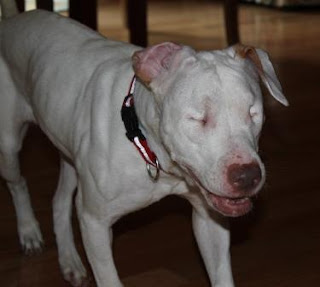
Although I am going to skirt some details here, let me give you the background to my trip last week. In 2009 a man was arrested in Philadelphia and arrested for animal cruelty. Five dogs, identified as "Pit Bulls", were seized. Two of those survived and were eventually transferred to Rescue. Here is one, a little girl named Emily:

Emily
Emily had a rough time in her prior captivity, and after being rescued had to have both of her eyes surgically removed. To jump ahead, Emily is now safe, after many travels, happily bumping about in the living room of Kathy McGuire of New Jersey Aid for Animals. Emily may not have eyes, but after spending time with her I can say that she sees far better with her heart than most of us "fully sighted" people.
To go on with the story, time passes.....and in August, 2011 police are again called to the same residence, same abuser, five new dogs. This time they find both a dog and a human dead. The human victim was a mentally ill woman, off her medications, that appears to have stabbed one of the dogs to death. The stabbed dog presumably managed to kill the attacking human before he expired from his wounds. The other four dogs, although present, were never positively identified as having taken part in the attack on the human, although detailed forensic testing was not undertaken. These four remaining dogs were taken into the custody of Philadelphia Animal Control. The dogs were, at the instruction of the City of Philadelphia, isolated in double kennels, forbidden any outside time or human contact. I know that it must have been hard for the staff of Philadelphia Animal Control to have to watch these dogs languish, no human contact at all. In fact, according to the rules imposed on them, the staff had to drop a guillotine door down in the kennels separating the dogs in one side, place food in the unoccupied side of the kennels, then raise the door to let each dog have access to their food. No pets, no walks, no outside exercise-nada.
But as tends to happen, angels appeared. A benefactor found out about the dogs' plight. Kathy McGuire and attorneys Robert Muensch and Nadia Adawi stepped in and found that the dogs were not altogether forsaken. They got support from the local DA and the Court and secured a Court Order that allowed evaluation of these dogs for the purpose of relocation to a sanctuary rather than simple destruction.
Which is where I came in.
After stopping in at the 2012 No Kill Conference at George Washington University in Washington, DC for two days I made the trek up to Philadelphia. With Nadia as my trusty camera person, and accompanied by the wonderful Irv Samuel we went to Philadelphia Animal Control and met the dogs, Bleu, Goldi, Shorty and Pepper.
Now remember-these four were accused of being involved in a human fatality. The Animal Control facility had been under strict rules, imposed by the City, that the dogs were not allowed any direct human contact, no training, nothing: I had no idea what I was going to meet when I tried to establish contact and evaluate them.
So I put on my Kevlar gloves, strapped on my heavy protective chaps (sorry for the camo-that's the color they came in, and bruising is a heck of a lot better than loosing flesh in a bad bite), and met the beasts.
And made solid friends.
The first dog, Bleu, was reported to be the "most dangerous" of the four, so that is where I started. Although the full evaluation went for over an hour, here is a bit that Nadia put together with a musical background. Watch this, remember the circumstances this dog had been kept under, and bring out your tissues....
This boy exemplified all the great things about dogs-and their seemingly unlimited capacity to forgive and accept humans for the damaged creatures we are. Bleu started out fearful in his kennel-understandable-but within a very short time he was allowing me to pet him, handle him freely, and he was voluntarily seeking proper, appropriate contact and play! Granted, he is a bit of a butthead, wanting to be a bit pushy, but he accepted gentle correction, both physical and verbal, and never once showed me a single sign of aggression-offensive or defensive. And when he came outside....the joy on his face to feel the sunshine and fresh air made all the cases where dogs were too damaged or deficient to be safely moved along easier to take for a moment.
Now, is Bleu ready to go jumping back into a loving family? Not quite. He still needs manners (he is a strong boy), some rehab, and a carefully chosen placement that understands his background (FULL DISCLOSURE PLEASE) and is willing to accept the training and management he may require. I am not sure I would risk him with kids until he has better manners-mostly because he is strong and jumps up. But Bleu is saveable.
I also worked with Shorty and Goldi. They too are saveable, with cautions and informed placement. Shorty is also a strong boy needing manners, although he is less pushy than Bleu. Goldi, on the other hand, is very soft and will need a sensitive touch to bring her up a bit and give her some needed confidence. Pepper sadly is the down part of this story. She went into the abusive home very young, was removed a year ago at probably a year of age, and has spent the last year in isolation. She is extremely fearful, and her quality of life has to be affected by that overwhelming fear. She did snap three times at me, all in fear, and even though I sat with her for over an hour I was never able to touch her or reassure her that the world was an OK place. She is the down side of this case. However, three out of four is to me, when mostly the dogs are all destroyed, a winning day.
So these three dogs are still at Philadelphia Animal Control with Kathy McGuire of New Jersey Aid for Animals working hard and fast to find them safe sanctuary and rehabilitation. Kathy can be contacted at 856-498-3978. If you are a sanctuary or rehab facility that can satisfy the City and is willing to take on these guys, please call Kathy. We don't have a lot of time.
And remember-not all dogs in the world can be saved, but to the ones that can, it means the world.
Friday, July 20, 2012
Behavior vs BSL-A distinction that would have saved Lennox
In the wake of Lennox’s death in Northern Ireland there has
been a huge hue and cry against Breed Specific Legislation across the
world. I fully support the eradication
of this discriminatory type of legislation, but the fact remains: there are
dangerous dogs out there. We need a
strategy on how to identify them and what to do with them.
In this post, I want to try and offer a constructive
solution. There is, I believe, a way to address vicious and dangerous dogs,
protect public safety, hold owners of dangerous dogs accountable, and place the
ultimate responsibility where it belongs-on the humans involved. And when I speak in this article about
Dangerous Dogs, I am referring to dogs that have been legally declared as such
after whatever specific procedure a jurisdiction imposes. There are no such things as inherently dangerous dogs. Period.
The basis of my suggested solution is that we need to
directly address behavior. Not
appearance, not beliefs, not rumor, not myth or fantasy. We need to base our strategy on facts, direct
observation, and sound behavioral principles.
It really doesn’t matter what a dog looks like. Unlike Medusa, no dog is capable of turning
anyone to stone or causing them to fall dead from a look. For a dog to cause injury it must act. Action is behavior. Behavior can be described, measured,
quantified. Dangerous behavior can be
dealt with likewise; defined, measured, and quantified. An animal manifesting specific behaviors,
accurately described and quantified, can be dealt with in an appropriate manner,
and the human responsible for that animal can be held accountable.
The first thing we need to do is accurately describe and
quantify the behavior. Dr. Ian Dunbar,
founder of Sirius Dog Training (http://www.siriuspup.com)
developed a six level bite assessment tool for use in evaluating and comparing
dog bites. The tool is available online
here: (http://www.apdt.com/veterinary/assets/pdf/Ian%20Dunbar%20Dog%20Bite%20Scale.pdf)
For those unfamiliar with this scale, it rates dog bites on
Levels ranging from 1 to 6. Level 1 is
threatening behavior with no physical contact; Level 6 is an incident resulting
in a human fatality. This assessment scale lets us specifically define the
parameters of a bite (depth, intensity and number of bites) and gives us solid
ground to compare one bite to another, across jurisdictions, circumstances, and
dog sizes. No where in this tool does
breed come into play.
By quantifying an incident we can then define our response
to these incidents with clear, scalable categories. We can then use this categorization to
develop Dangerous Dog regulations that are based on the number of defined
incidents that occur within a specific time period.
A Level 1 incident involves a dog barking, growling, lunging
and otherwise clearly menacing a person without physical contact. A Level 2 incident progresses to minimal skin
contact by teeth without puncturing the skin.
A community could establish an ordinance along the following lines.
“Any dog that
commits three (3) Level 1 or Level 2 incidents, when unprovoked and off the
owners’ property, documented by the responsible investigating authority and
attested to by sworn affidavit, within a period of two (2) years may be deemed
a Potentially Dangerous Dog. Such a dog
shall be required to attend an approved obedience class or receive approved
behavior remediation. The owner may be
fined up to $X.00 upon the third incident within the listed time period. Any further incidents by the Potentially
Dangerous Dog shall result in the dog being declared Dangerous.
Any
dog that is responsible for three (3) level 3 incidents, when unprovoked and
off the owners’ property, within a period of two (2) years may be declared
Dangerous and be required to adhere to all regulations of such. Those shall include (insert various
regulations)
Any
dog that inflicts a Level 4 or 5 bite shall be declared Dangerous.”
And so on. I also
like to include some wording that threatening behavior must be held to the
standard of a reasonable person. I had
to investigate a claim that a dog, a Bassett Hound, was dangerous. When I observed the dog he was snoozing in
the sun in his front yard. He barely
woke enough to look at me as I stepped over him to ring the doorbell. When I met with the complainant, she said
that the dog “looked” at her and thus threatened her. Come to find out she was phobic about
dogs. That case went no further as her
response did not meet the level of what a reasonable person would perceive as a
threat.
Ultimately the various details, such as response numbers and
time periods can easily be adapted to the needs and desires of a local
community. Intermediate responses can be
more detailed too-say, after the second Level 1 or 2 incident the dog owner may
receive a written warning and lesser fine, with a strong suggestion that their
dog receive training or behavioral treatment.
A city could provide lesser regulation for a dog with 3 Level 3 bites,
but then drop the hammer if a fourth bite, or even threatening behavior occurs.
I have recommended requiring three minor incidents and a specific
time factor for a reason. Anyone, man or
beast, can make a small mistake from time to time. The first minor incident (not Level 4 or 5)
can be understood and is often taken as evidence of a need for training in
responsible owners. I certainly get
enough calls from first time incident families.
A second incident is a clue that there is a deficit, human or dog, but
still (in my opinion) is in the range of accidental behavior. By the time we are at three incidents, we
definitely have a problem. Usually we
have an owner that is just not acting responsibly and needs to be held
accountable, but we also have dog behavior that needs addressing.
As far as the time factor goes, if a puppy has two minor
incidents at six months, and then goes ten or twelve years until he nips a person
as an aged, grumpy old guy, that does not a Dangerous Dog make. There should be, for minor incidents, a rational and reasonable time frame. Level 4 and 5 incidents show a much greater
danger and should be dealt with firmly and immediately.
Most importantly there should be sanctions against humans
who fail to address dangerous behavior.
Any owner of a declared Dangerous Dog who has another incident should be
facing jail, period. If Sparky has been
declared Dangerous for a Level 4 bite and then ever bites again, the owner must
be held to account. The punishment can
logically vary with the severity of the incident (using the assessment tool again). For a Dangerous Dog that is a Level 3 biter, and
then inflicts another Level 3 bite, maybe a misdemeanor charge against the
owner is appropriate. A Dangerous Dog
that inflicts a Level 4 or 5 bite after the declaration should result in felony
charges for the owner.
Once again, the details can be tweaked by the local
jurisdiction. The essential issue here
is that the determination of whether a dog is Dangerous must be based on clear,
quantifiable criteria. Those criteria
must apply to all dogs, preferable in proportion to their size. A Chihuahua that sinks his whole jaw into
someone’s leg, even though the bite is relatively small in size, is a Dangerous
Dog and needs to be regulated as such.
They are a threat, and the damage inflicted is only smaller because they
are physically smaller. A big dog that
bites but only leaves a single puncture less than half the length of its canine
tooth is a Level 3 biter-no matter how large he is.
We have to discard the notion that breed or type of dog
somehow makes them inherently dangerous-or somehow automatically safe. Every dog has the potential of being either.
We must define and quantify behavior that is unacceptable-not looks.
Thursday, July 12, 2012
Lennox: The gloves come off.
PRE-AFTER NOTE (It makes sense in just a second) IN RESPONSE TO CONCERNED COMMENTS:
For those concerned about my comment that I had remained in the background on this up 'till now: I was working along with Victoria for about a year. We presented me as an independent, unallied and qualified expert to come re-evaluate Lennox. I kept my prior comments on this blog thoughtful and low key in order to try and be able to do what I do-give a fair, balanced, and professional assessment. Making a public fuss, even though I already had my reservations, would not have helped to gain the possible access we sought. And in all honesty (which was expressed to the parties in charge), if I had gone to NI and evaluated Lennox and found him dangerous, I would have publicly said so! Now I am able, since there is no longer a chance of coming in from "outside" as a non-threatening presence, to put my feelings and the story of my/our efforts out there. My prior reticence was in Lennox' interest; too much said too soon without full access and information would have done nothing to help. Please know that, out of the public spotlight, I have been eager, ready and willing to step in at any point and bring my professional experience to bear. Believe me when I tell you that I am sick thinking that, just maybe, if I had gone sooner.....and then, as we all do, I guess myself into a corner. The BCC has had the controls the entire time. We can only know go forward and try to keep this from happening again.
Jim
First warning: This is going to be a long one. Grab a drink and settle back-we have some talking to do.
From the beginning of my involvement with the Lennox case (which dates back almost a year to when Victoria Stilwell brought me in) I have stayed as neutral and professional as possible. I have resisted criticising the BCC and their evaluator, as we were trying to get me to Northern Ireland and get access to Lennox to give a fair, objective, and behaviorally sound evaluation. Sarah Fisher had done a great job, but I brought extensive "Pit Bull" experience coupled with unparalleled experience with "killer dogs" (dogs that have taken human lives). So I kept my opinion considered and low key, hoping that I could have come in as an "outside" expert, supplemented Victoria and Sarah's efforts, and gotten the BCC to listen. Now that Lennox is dead and the case is over, I no longer have to hold my tongue.
Let's look at the "qualifications" of the only evaluation that the BCC or Court accepted. The BCC "evaluator" is, admittedly, a former police Constable. So am I, except that instead of being a Constable, the equivalent here in the US to a base Patrolman, I retired as a Lieutenant and Watch Commander, the UK equivalent of a full Inspector with the Metropolitan Police. I am also a certified Behavior Consultant (he has no such training), have been certified as a Professional Dog Trainer, and am trained and certified as a behavior evaluator by several organizations-and he is not. I have further, over the years, worked with, trained, and evaluated what are probably over a thousand Pit Bulls and other breeds prohibited in the UK, certainly more than the BCC evaluator.
In fact, their evaluator, who's evaluation history seems to be summed up by "knows a Pit Bull when he is paid to find one" isn't even a dog show judge. Wouldn't a conformation expert such as a show judge have been a better choice if we were going to see if a dog physically met a breed standard?
Sarah Fisher, a bona-fide behaviorist, issued her opinion as to Lennox' safe demeanor, but her opinion was spurned. One suspects that the BCC had issues with the opinion of a "mere woman" despite her clear qualifications.
So another outside evaluator, with credentials, was brought in by the Barnes family, this time a man. David Ryans conducted a second evaluation, and was also rejected by the BCC. Rumor had it at the time that they did not consider Ryans experienced enough with prohibited breeds.
All that said, I have looked carefully at the video of Mr. Ryans, and would like to walk you all through what I see.
The video I am referring to is posted online here: http://lennoxsandielightfoot.blogspot.com/2012/07/video-of-sandie-lightfoot-and-belfast.html The times given refer to the times listed on the running video.
The test starts with Lennox on leash, held by a female Animal Control person, with both the Animal Control person and David Ryans (presumably a stranger to Lennox), a behaviorist, seated in chairs. Lennox is being petted by the female. Lennox is seated and seems to be relaxed.
As Mr. Ryans is placing a notebook into a bag at his side, Lennox approaches under Mr. Ryans' leg to see what he is doing. He shows no fear or reticence towards Ryans, just mild interest in the bag. Ryans places his open hand directly on Lennox snout to pet him and guide him back from under Ryans' legs.
Lennox returns to the seated female and seeks her attention (about 32 seconds in). Mr. Ryans then proffers a treat repeatedly to Lennox, extending it and then removing it from Lennox' reach. Lennox is focused on the treat, but allows Ryans to take the treat back repeatedly with no sign of possession aggression or reluctance. Lennox never snaps, lunges, or does anything other than wait for Ryans to surrender the treat. Lennox does, for a moment, try to get up and approach Ryans and the treat, but immediately returns to a sit when asked. Lennox' responses are positive and he readily seeks appropriate, positive contact with Ryans' Lennox does briefly try to get in Ryans' lap, but responds immediately when asked to get off. Ryans appears to "pop" Lennox on the snout several times with an open hand (about 1:27) to elicit a response. Lennox briefly and calmly retreats, but continues to try and make positive contact with Ryans with no defensive or aggressive display.
Ryans then stands up. Lennox continues to make appropriate positive contact, and shows no negative response to Ryans despite his looming stance over Lennox. Lennox watches as Ryans turns away and reaches for more treats. Lennox makes no attempt to go after Ryans while his back is turned.
Lennox then allows Ryans to approach frontally and back him up, almost to the wall, with Ryans maintaining a tall, directly frontal stance. Lennox sits attentively. Ryans then challenges Lennox with a direct, frontal stare. Lennox responds peacefully, turning his head, and remains calm, retreating briefly and returning to the handler, then partially turning away to defuse the challenge of Ryan's. At no time did Lennox show even the most remote aggressive response to this stranger, Mr. Ryans.
Now, please compare my notes here to an evaluation I conducted regarding a frankly aggressive animal we will call "JoJo" (not his name). Remember-these following notes are an aggressive dog, NOT Lennox!
"JoJo did not allow me to make direct contact. JoJo is very suspicious of others. When he was out XXX was holding him. JoJo was tense and alert. JoJo reacted violently to sustained eye contact, in full lunge and attack mode, teeth bared and barking/growling strongly. Once JoJo reacted to me he kept a very wary eye on me and did not relax. WARNING: JOJO HAS DISPLAYED HUMAN FOCUS AGGRESSION. JOJO MAY BE A THREAT TO HUMANS. JOJO IS A HIGH LIABILITY DOG. Humane containment and management is the best strategy for him."
Does this look a little different from the objective appraisal of Lennox? I certainly think so."JoJo" was clearly an aggressive dog, and reading my assessment of Lennox, or watching the video, shows the reality of Lennox' interaction with Mr. Ryans-completely non-aggressive.
For those wanting to see the evaluation of another dog accused of aggression that turned out NOT to be an aggressive dog, please watch the following: http://www.youtube.com/watch?v=VHdpQP76WKs
You will see that this evaluation is far more extensive, and is conducted with this "killer" dog unrestrained. Helo's evaluation included substantial direct contact between me and the dog, and let me see far more of Helo's true behavior. Mr. Ryan was operating under the constraints imposed by the BCC. I will bet that the BCC evaluator never interacted freely with Lennox. I also suspect that the BCC evaluator never grabbed Lennox by the face, never met his gaze eye-to-eye, never tried to take a food bowl away-in fact, I would guess that their evaluator's whole opinion was derived from a closely limited situation like they imposed on Mr. Ryan. That is not a fair or appropriate evaluation.
The evaluation for that dog, Helo, is summarized here:
I am so sorry Lennox. We tried to get you a fair shot. I just hope your death serves to be the seed for change, and that your sacrifice motivates others to fight unfair laws based in ignorance and hate.
For those concerned about my comment that I had remained in the background on this up 'till now: I was working along with Victoria for about a year. We presented me as an independent, unallied and qualified expert to come re-evaluate Lennox. I kept my prior comments on this blog thoughtful and low key in order to try and be able to do what I do-give a fair, balanced, and professional assessment. Making a public fuss, even though I already had my reservations, would not have helped to gain the possible access we sought. And in all honesty (which was expressed to the parties in charge), if I had gone to NI and evaluated Lennox and found him dangerous, I would have publicly said so! Now I am able, since there is no longer a chance of coming in from "outside" as a non-threatening presence, to put my feelings and the story of my/our efforts out there. My prior reticence was in Lennox' interest; too much said too soon without full access and information would have done nothing to help. Please know that, out of the public spotlight, I have been eager, ready and willing to step in at any point and bring my professional experience to bear. Believe me when I tell you that I am sick thinking that, just maybe, if I had gone sooner.....and then, as we all do, I guess myself into a corner. The BCC has had the controls the entire time. We can only know go forward and try to keep this from happening again.
Jim
First warning: This is going to be a long one. Grab a drink and settle back-we have some talking to do.
From the beginning of my involvement with the Lennox case (which dates back almost a year to when Victoria Stilwell brought me in) I have stayed as neutral and professional as possible. I have resisted criticising the BCC and their evaluator, as we were trying to get me to Northern Ireland and get access to Lennox to give a fair, objective, and behaviorally sound evaluation. Sarah Fisher had done a great job, but I brought extensive "Pit Bull" experience coupled with unparalleled experience with "killer dogs" (dogs that have taken human lives). So I kept my opinion considered and low key, hoping that I could have come in as an "outside" expert, supplemented Victoria and Sarah's efforts, and gotten the BCC to listen. Now that Lennox is dead and the case is over, I no longer have to hold my tongue.
Let's look at the "qualifications" of the only evaluation that the BCC or Court accepted. The BCC "evaluator" is, admittedly, a former police Constable. So am I, except that instead of being a Constable, the equivalent here in the US to a base Patrolman, I retired as a Lieutenant and Watch Commander, the UK equivalent of a full Inspector with the Metropolitan Police. I am also a certified Behavior Consultant (he has no such training), have been certified as a Professional Dog Trainer, and am trained and certified as a behavior evaluator by several organizations-and he is not. I have further, over the years, worked with, trained, and evaluated what are probably over a thousand Pit Bulls and other breeds prohibited in the UK, certainly more than the BCC evaluator.
In fact, their evaluator, who's evaluation history seems to be summed up by "knows a Pit Bull when he is paid to find one" isn't even a dog show judge. Wouldn't a conformation expert such as a show judge have been a better choice if we were going to see if a dog physically met a breed standard?
Sarah Fisher, a bona-fide behaviorist, issued her opinion as to Lennox' safe demeanor, but her opinion was spurned. One suspects that the BCC had issues with the opinion of a "mere woman" despite her clear qualifications.
So another outside evaluator, with credentials, was brought in by the Barnes family, this time a man. David Ryans conducted a second evaluation, and was also rejected by the BCC. Rumor had it at the time that they did not consider Ryans experienced enough with prohibited breeds.
All that said, I have looked carefully at the video of Mr. Ryans, and would like to walk you all through what I see.
The video I am referring to is posted online here: http://lennoxsandielightfoot.blogspot.com/2012/07/video-of-sandie-lightfoot-and-belfast.html The times given refer to the times listed on the running video.
The test starts with Lennox on leash, held by a female Animal Control person, with both the Animal Control person and David Ryans (presumably a stranger to Lennox), a behaviorist, seated in chairs. Lennox is being petted by the female. Lennox is seated and seems to be relaxed.
As Mr. Ryans is placing a notebook into a bag at his side, Lennox approaches under Mr. Ryans' leg to see what he is doing. He shows no fear or reticence towards Ryans, just mild interest in the bag. Ryans places his open hand directly on Lennox snout to pet him and guide him back from under Ryans' legs.
Lennox returns to the seated female and seeks her attention (about 32 seconds in). Mr. Ryans then proffers a treat repeatedly to Lennox, extending it and then removing it from Lennox' reach. Lennox is focused on the treat, but allows Ryans to take the treat back repeatedly with no sign of possession aggression or reluctance. Lennox never snaps, lunges, or does anything other than wait for Ryans to surrender the treat. Lennox does, for a moment, try to get up and approach Ryans and the treat, but immediately returns to a sit when asked. Lennox' responses are positive and he readily seeks appropriate, positive contact with Ryans' Lennox does briefly try to get in Ryans' lap, but responds immediately when asked to get off. Ryans appears to "pop" Lennox on the snout several times with an open hand (about 1:27) to elicit a response. Lennox briefly and calmly retreats, but continues to try and make positive contact with Ryans with no defensive or aggressive display.
Ryans then stands up. Lennox continues to make appropriate positive contact, and shows no negative response to Ryans despite his looming stance over Lennox. Lennox watches as Ryans turns away and reaches for more treats. Lennox makes no attempt to go after Ryans while his back is turned.
Lennox then allows Ryans to approach frontally and back him up, almost to the wall, with Ryans maintaining a tall, directly frontal stance. Lennox sits attentively. Ryans then challenges Lennox with a direct, frontal stare. Lennox responds peacefully, turning his head, and remains calm, retreating briefly and returning to the handler, then partially turning away to defuse the challenge of Ryan's. At no time did Lennox show even the most remote aggressive response to this stranger, Mr. Ryans.
Now, please compare my notes here to an evaluation I conducted regarding a frankly aggressive animal we will call "JoJo" (not his name). Remember-these following notes are an aggressive dog, NOT Lennox!
"JoJo did not allow me to make direct contact. JoJo is very suspicious of others. When he was out XXX was holding him. JoJo was tense and alert. JoJo reacted violently to sustained eye contact, in full lunge and attack mode, teeth bared and barking/growling strongly. Once JoJo reacted to me he kept a very wary eye on me and did not relax. WARNING: JOJO HAS DISPLAYED HUMAN FOCUS AGGRESSION. JOJO MAY BE A THREAT TO HUMANS. JOJO IS A HIGH LIABILITY DOG. Humane containment and management is the best strategy for him."
Does this look a little different from the objective appraisal of Lennox? I certainly think so."JoJo" was clearly an aggressive dog, and reading my assessment of Lennox, or watching the video, shows the reality of Lennox' interaction with Mr. Ryans-completely non-aggressive.
For those wanting to see the evaluation of another dog accused of aggression that turned out NOT to be an aggressive dog, please watch the following: http://www.youtube.com/watch?v=VHdpQP76WKs
You will see that this evaluation is far more extensive, and is conducted with this "killer" dog unrestrained. Helo's evaluation included substantial direct contact between me and the dog, and let me see far more of Helo's true behavior. Mr. Ryan was operating under the constraints imposed by the BCC. I will bet that the BCC evaluator never interacted freely with Lennox. I also suspect that the BCC evaluator never grabbed Lennox by the face, never met his gaze eye-to-eye, never tried to take a food bowl away-in fact, I would guess that their evaluator's whole opinion was derived from a closely limited situation like they imposed on Mr. Ryan. That is not a fair or appropriate evaluation.
The evaluation for that dog, Helo, is summarized here:
"I first observed Helo inhis kennel. He came to the front of thekennel as I passed and was alert and quiet. I then proceeded to the fenced play area at the facility and had Helobrought out to me to interact and greet off leash. Helo greeted me readily and appropriately,sniffing and alert. He approached headup, with no show of shyness or aggression. He readily sought contact but was also interested in checking out theimmediate area.
Helo readily allowed me topet him, and then allowed ready manipulation of his head, ears, mouth, andtail. He allowed me to manipulate hisrear feet, but was sensitive to handling of his front legs, consistent with theexpected behavior of an animal that has recently received a leg injury. His right front leg still showed visibleswelling. I grasped Helo by the sides ofhis face and, at close range, met his gaze directly. Helo broke eye contact first and did notgrowl, stiffen his posture, or show any typical signs of stress oraggression. Helo repeatedly allowed meto grab his collar, stand over him, and examine his bite and teeth formeasurements. I conducted a “squeezetest” wherein the tester grabs handfuls of fur and skin and gently squeezes todetermine the tested dog’s reactions. Helo did turn his head towards my hand as I proceeded down his body, butdid not open his mouth, snap, nip, or muzzle-punch in reaction. His body posture remained neutral during thistest.
I offered Helo high-valuetreats (Pupperoni) and he took them readily. Helo allowed me to proffer the treats and then remove them from his bitewith no resistance or attempt to guard or protect the treats. I also gave Helo a bowl of food (he had notreceived his morning feeding yet) and he allowed me to present and remove thefood repeatedly. Helo allowed me tomanipulate his face while eating, and only gave a minimal grumble when Iphysically placed my hand into the kibble he was eating while he ate.
Helo is fairly wellbehaved, sitting on command fairly often (approximately 70%) and has a lesserresponse to being called (about 30%).
Helo exhibited nosensitivity to loud noises or strange objects."
Note that my written evaluations of Lennox, "JoJo", and Helo never use language such as "the most dangerous dog I have ever seen" or any of the other nonsense that the BCC's evaluator has used. Such emotional language has no place in a behavioral assessment. My evaluations never mention the dogs' appearance, as physical appearance has absolutely no bearing on behavior. In fact, "JoJo" wasn't even a breed banned in the UK. Neither was Helo.
Lennox certainly got short shrift in this incident. The evaluator that the Court relied upon is clearly unqualified to assess temperament and behavior. He doesn't even have the credentials to assess adherence to a breed standard.
And frankly, if their evaluator thinks that Lennox was the "most dangerous dog" he had ever seen-please come meet some off the guys I have handled and evaluated after they have killed humans. I have seen more dangerous Cocker Spaniels. Please, if you are to be considered a professional, try not to embarrass yourself with such twaddle.
I am so sorry Lennox. We tried to get you a fair shot. I just hope your death serves to be the seed for change, and that your sacrifice motivates others to fight unfair laws based in ignorance and hate.
Friday, July 6, 2012
Lennox 07/06/2012 from Victoria Stilwell
For my readers who may not be following Victoria Stilwell, who has been involved in the Lennox case in Northern Ireland for many months (and who brought it to my attention first almost a year ago) here is the latest news from Belfast. I support Victoria's efforts in this case, have been available to back her up in her fight to fight to get Lennox fair treatment, and remain her ally and supporter in these times. Victoria is Lennox' last hope. Cross your fingers and keep positive!
From Victoria's post of 07/04/2012-copyright Victoria Stilwell, 2012.
From Victoria's post of 07/04/2012-copyright Victoria Stilwell, 2012.
"As most close observers of Lennox’s case now know, the legal process which had been undertaken in an attempt to return the dog to the Barnes family (his owners) has run its course to no avail. I remain in close contact with the Barnes family and continue to be amazed by their resolve and courage while attempting to save their beloved boy’s life. It is important to understand that every possible legal avenue to release Lennox back to the family has been exhausted, and that result is no longer an option. Indeed, the latest news is that he is scheduled to be euthanized next week. My heart goes out to Craig, Caroline and Brooke for what they are enduring.
Over the past year, I have received many generous and kind-hearted offers from those wishing to help on Lennox’s behalf, and I have ensured that the Barnes family and Lennox’s legal team have been made aware of all of these.
Several months ago, I began working behind the scenes with Lennox’s legal team to begin the process of convincing the court system to allow Lennox to be rehomed in the US – a process which I personally am dedicated to overseeing and facilitating if it is allowed by the court. I have personally received the Barnes family’s approval to take Lennox, and while I can only imagine the heartache they would feel at seeing him go, they have said they would prefer him to have a happy life elsewhere rather than see it end next week. My longstanding private offer to absorb all of the cost and organize all of the travel arrangements to transport him at no expense to the Belfast City Council has been with those responsible for making the final decisions regarding Lennox for some time. Indeed, we are currently awaiting a response to the legal team's request to the BCC to meet with me directly to discuss options. As of this morning, we have not had an official response from the BCC regarding this offer.
I’d like to be clear about something: while I detest Breed-Specific Legislation (BSL) and laws such as the UK’s Dangerous Dogs Act which are responsible for the incarceration and destruction of dogs like Lennox all over the world, I understand the difficult position municipalities are put in during situations like this. While I do believe that the BCC and court system have made significant errors in the handling and prosecution of Lennox’s case, I do not ever advocate overturning the rule of law and re-writing legislation on the fly as we see how it affects our personal daily lives. We cannot bend and reshape standing laws in our societies any time we don’t like the outcome they provide. Instead, we must refocus our efforts on changing inappropriate and dangerous laws completely from the top down, which is why I’ve been railing against the UK’s Dangerous Dogs Act legislation for many years. Lennox’s impending euthanasia is but one of hundreds of examples of how this law unfairly prosecutes perfectly well-adjusted pets while failing to truly protect the public from dangerous dogs – the purported aim of the legislation in the first place. We must not allow Lennox’s and the Barnes family’s ordeal to be in vain – let’s all unite behind a concerted, positive effort to overturn the Dangerous Dogs Act in the UK and other laws just like it currently on the books in countless other parts of the world.
So to the Belfast court system and the BCC, I now publicly give you my word that if you remand custody of Lennox to me and allow me to take him to a safe place in the US, I will not disparage the BCC, the Belfast court system, or those involved with this case in any way moving forward. Indeed, I will publicly recognize the courage that it will take to rise above the divisive voices clamoring on both sides of this issue, follow the law, and yet also show some humanity and allow this dog to live out his final years in peace in the US. I recognize that although I wholeheartedly and passionately disagree with the repeated rulings that found him to be a dangerous dog, once he was found to be guilty, you have little choice but to enforce the law. All I’m asking is that you recognize the special nature of this case and allow him to leave the country – a result which still allows you to uphold the spirit of the law while avoiding the death of what I and many others consider to be an innocent dog and averting an even more damaging end to what has undoubtedly become a public relations nightmare.
I’m in Dublin tonight and will be in Belfast over the weekend and at the beginning of next week to visit with the Barnes family and explore any last-ditch efforts to save Lennox. I’ll post any updates here, and I also encourage you to visitLennox’s official page.
Click the links below to read other articles from myself and others:
Sarah Fisher’s Lennox Statement
Jim Crosby’s Lennox Statement
Victoria’s Blog
Sarah Fisher’s Lennox Statement
Jim Crosby’s Lennox Statement
Victoria’s Blog
Monday, July 2, 2012
Lennox update 07/02/2012
An update from the Barnes family on the Lennox issue: the following was posted this afternoon (July 2, 2012) on the Save Lennox Facebook page. I want to share this with all of my readers. Please keep Lennox and his family in your thoughts.
Official Statement From Lennox's Family:
We apologise for the silence as we know our many friends and supporters around the world have been desperate for news but until we had further talks with our legal team we had nothing new to share. We needed to explore all possible options before we issued another statement as we did not wish to give those that have campaigned so tirelessly any false hope or for anything to be taken out of context as has happened in the past.
Whilst there may well be errors in the Judge’s ruling from a point of law this has little bearing on whether we can or should progress by taking the case to a higher court. The ruling is based on the Judge’s decision that he deems Lennox to be unsafe despite evidence given by those qualified to assess and understand dog behaviour that contradicts the testimony of the Prosecution that was presented in court. This has given us little room for manoeuvre.
Our concern and priority has always been the welfare of our beloved boy. We have fought to have Len returned to our family from the moment he was seized but we have been advised that the legal fight is at an end. We are obviously distraught but have to consider the impact that any future lengthy legal battle would have on Len if we chose to go against the advice that we have been given. We cannot subject him to any more as there are no grounds for a further appeal and we do not wish to prolong his suffering any longer by engaging in a battle that we simply cannot win.
We have attempted to write this statement many, many times but have struggled to put in writing that the fight to spare Lennox’s life may well be over. It has been almost impossible for us to accept that we have to admit defeat. We always believed that there was some hope and that justice would prevail. We were wrong. There have been many dark days for us since Len was taken and we want you all to know that it is your support and kindness that kept us going through the blackest times.
This is all we can share with you at the moment and we are finding it hard to come to terms with the fact that there is nothing more that we can do from a legal point of view and that Lennox may well be killed. We have one last hope that Belfast City Council will allow Lennox to be rehomed in the USA. The offer is there but we have no say in whether this offer will be accepted. We have never refused to rehome Lennox. That decision was taken out of our hands from the moment Len took his final walk with us from our house to the Dog Wardens van.
If the offer is turned down we will fight for our right to say goodbye. We cannot bear the thought that Lennox will die without being reminded of the hearts and hands that love him.
Thank you.
Official Statement From Lennox's Family:
We apologise for the silence as we know our many friends and supporters around the world have been desperate for news but until we had further talks with our legal team we had nothing new to share. We needed to explore all possible options before we issued another statement as we did not wish to give those that have campaigned so tirelessly any false hope or for anything to be taken out of context as has happened in the past.
Whilst there may well be errors in the Judge’s ruling from a point of law this has little bearing on whether we can or should progress by taking the case to a higher court. The ruling is based on the Judge’s decision that he deems Lennox to be unsafe despite evidence given by those qualified to assess and understand dog behaviour that contradicts the testimony of the Prosecution that was presented in court. This has given us little room for manoeuvre.
Our concern and priority has always been the welfare of our beloved boy. We have fought to have Len returned to our family from the moment he was seized but we have been advised that the legal fight is at an end. We are obviously distraught but have to consider the impact that any future lengthy legal battle would have on Len if we chose to go against the advice that we have been given. We cannot subject him to any more as there are no grounds for a further appeal and we do not wish to prolong his suffering any longer by engaging in a battle that we simply cannot win.
We have attempted to write this statement many, many times but have struggled to put in writing that the fight to spare Lennox’s life may well be over. It has been almost impossible for us to accept that we have to admit defeat. We always believed that there was some hope and that justice would prevail. We were wrong. There have been many dark days for us since Len was taken and we want you all to know that it is your support and kindness that kept us going through the blackest times.
This is all we can share with you at the moment and we are finding it hard to come to terms with the fact that there is nothing more that we can do from a legal point of view and that Lennox may well be killed. We have one last hope that Belfast City Council will allow Lennox to be rehomed in the USA. The offer is there but we have no say in whether this offer will be accepted. We have never refused to rehome Lennox. That decision was taken out of our hands from the moment Len took his final walk with us from our house to the Dog Wardens van.
If the offer is turned down we will fight for our right to say goodbye. We cannot bear the thought that Lennox will die without being reminded of the hearts and hands that love him.
Thank you.
Monday, June 18, 2012
Dog Bite Investigation Seminar, July 7 and 8, 2012
I would like to invite all those in the Central Missouri area, and anyone else wanting to come for a visit, to join me July 7th and 8th in Springfield, MO at Drury University for two days of dog bite seminars. Saturday the 7th will be an all day course on investigating dog bite fatalities, and the audience will be limited to Law Enforcement, Animal Control, prosecutors, attorneys, and judges. Some active cases will be discussed, so ID will be required at the door.
Sunday, July 8th, will be a public event addressing dog bite investigations and behavior behind dog bites for owners, trainers, and interested dog lovers. This will be a less technical presentation (less gore) and we will also discuss bite prevention and Breed Specific Legislation issues.
Both event are free due to the generosity of Drury University's Law Enforcement Academy, the Drury University Animal Studies Program, and local business sponsors, all of whom I thank in advance. Thanks also to Jennifer Kimberlin, who has run with this furiously to put it together, and Judy Luther, who suggested coming to Missouri and started the ball rolling.
AS I said, these events are free, but registration is required as we are limited to 100 seats each day. Attached below is the registration info-PLEASE JOIN US!

Sunday, July 8th, will be a public event addressing dog bite investigations and behavior behind dog bites for owners, trainers, and interested dog lovers. This will be a less technical presentation (less gore) and we will also discuss bite prevention and Breed Specific Legislation issues.
Both event are free due to the generosity of Drury University's Law Enforcement Academy, the Drury University Animal Studies Program, and local business sponsors, all of whom I thank in advance. Thanks also to Jennifer Kimberlin, who has run with this furiously to put it together, and Judy Luther, who suggested coming to Missouri and started the ball rolling.
AS I said, these events are free, but registration is required as we are limited to 100 seats each day. Attached below is the registration info-PLEASE JOIN US!

Subscribe to:
Posts (Atom)